NDSS SafeOSE '27 hands-on program
Open-Source AI Security Hackathon
Building effective and trustworthy open-source AI agent ecosystems.
AI agents increasingly operate through shared protocols, tool interfaces, identity systems, and open-source frameworks. This hackathon invites practical contributions that make those shared foundations more secure, private, interoperable, accountable, and resilient. Designs or implementations from excellent submissions will be incorporated into open standards and open-source repositories such as the Natural Language Interaction Protocol (NLIP), established as ECMA-430 and soon to be an ISO standard.
Projects may study, test, extend, or build on open AI-agent standards and ecosystems, including NLIP and other open protocols. Contributions can address individual components or risks that emerge when independently developed agents, tools, services, and users interact.
Hackathon focus areas
Design and implementation
Choose one of seven focus areas. Every area follows the same submission requirements and judging criteria.
01
Universal agent client
Build one client that can communicate with any NLIP-compliant agent, much as a web browser communicates with any HTTP/HTTPS server. Provide an effective user interface and demonstrate realistic use cases or innovative interactions.
View detailed brief ↓ 02Agent identity and authentication
Design interoperable mechanisms for establishing and verifying agent or user identity, credentials, and trust across technical and organizational boundaries.
View detailed brief ↓ 03Security functions at unified control points
Build a pluggable, framework-agnostic security function at an NLIP ingress, egress, or tool/model boundary. Demonstrate prevention, detection, or recovery against realistic attacks using data visible at the standardized communication layer.
View architecture and brief ↓ 04Schemas and structured NLIP messages
Design schemas for structured content carried by NLIP messages, conceptually like XML or HTML documents carried over HTTP/HTTPS, with an emphasis on validation and interoperability.
View detailed brief ↓ 05Representative multi-agent use cases
Build realistic multi-agent systems on the NLIP communication standard and show how independently developed agents cooperate across models, frameworks, and organizational boundaries.
View detailed brief ↓ 06Single-agent access control and cross-agent privilege delegation
Design access control for a single agent and/or secure, auditable cross-agent privilege delegation based on realistic use cases.
View detailed brief ↓ 07Other open-source AI ecosystem topics
Address other topics directly related to effective and trustworthy open-source AI ecosystems, with emphasis on challenges beyond AI agents.
View detailed brief ↓AREA 01Universal agent client
Create a universal client for AI agents using the NLIP protocol and standard. The goal is one client that can communicate with any NLIP-compatible agent, analogous to a web browser communicating with any server that supports HTTP/HTTPS.
- Discover, connect to, and exchange multimodal or structured messages with different NLIP agents.
- Provide effective user interfaces for sessions, agent capabilities, identity, consent, and results.
- Demonstrate realistic end-to-end use cases across different AI models, frameworks, or agent harnesses.
- Explore innovative interaction designs beyond today's single-agent chat interface.
AREA 02Agent identity and authentication
Develop interoperable identity and authentication mechanisms for users, agents, and services that communicate through open agent protocols.
- Address identity establishment, discovery, credentials, authentication, and trust across domains.
- Consider the lifecycle of credentials, including issuance, rotation, expiration, revocation, and recovery.
- Demonstrate user-to-agent and agent-to-agent authentication in realistic multi-party scenarios.
- Explain privacy, usability, deployment, and accountability tradeoffs.
AREA 03Security functions at unified control points
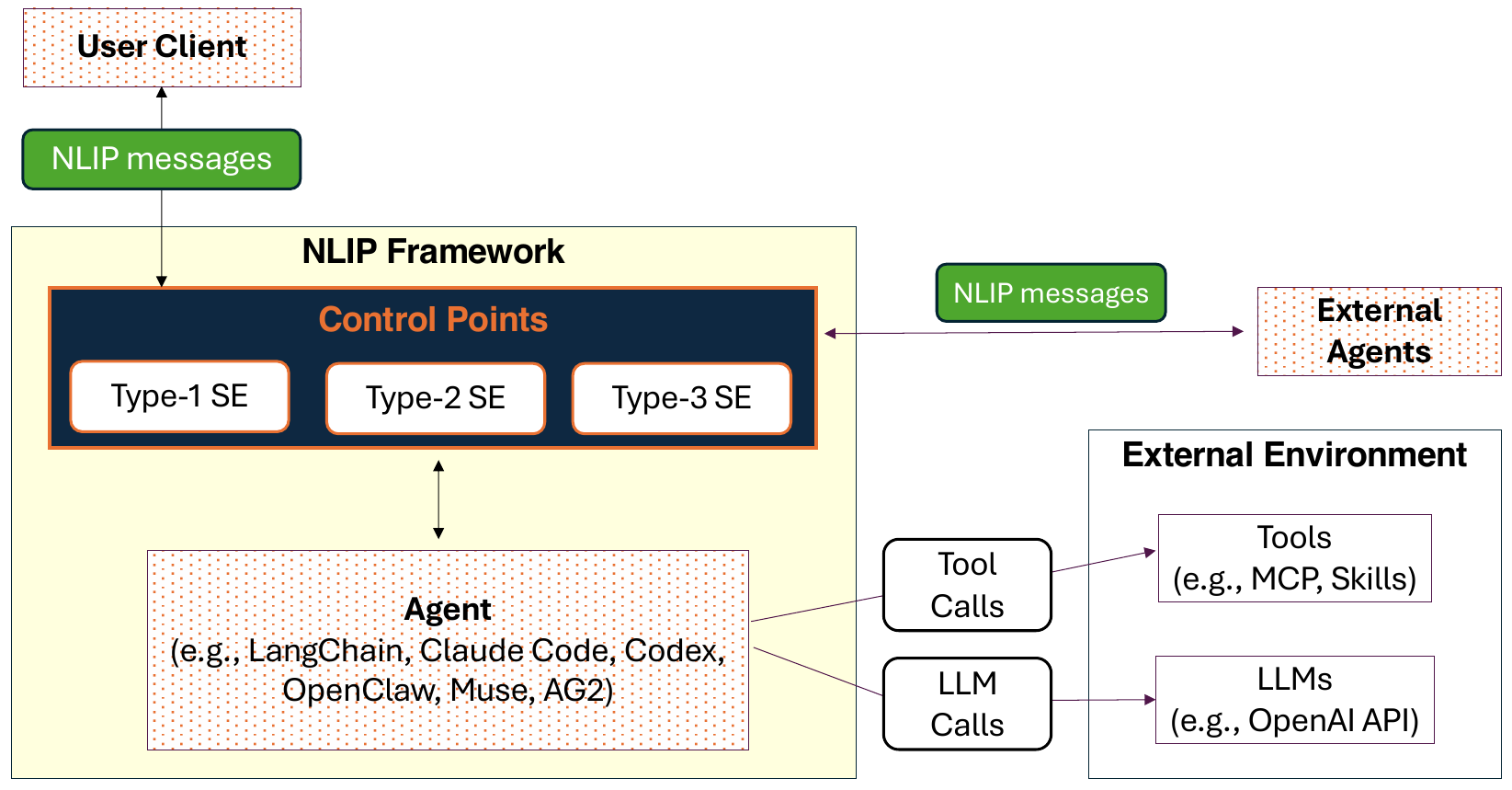
Figure 1 anchors the approach in a communication-layer control-point architecture. Structured NLIP messages connect agents with user clients—including people and mobile or web applications—and with other agents. Every incoming or outgoing NLIP message crosses a standardized boundary, making ingress and egress natural enforcement points for input- and output-driven attacks.
Like reference monitors in classical access-control systems, these control points support consistent validation, policy enforcement, and monitoring across heterogeneous agent implementations.
Task goal
Build one pluggable security function in the agent security architecture shown in Figure 1. Thoroughly evaluate it against relevant state-of-the-art attacks to demonstrate that the defense works effectively and efficiently.
Choose one enforcement location
- Ingress: inspect an incoming message before the agent processes it; block or clean up malicious or unsafe input.
- Egress: inspect an outgoing message before it leaves the agent; block or clean up malicious or unsafe output.
- Tool/model boundary: the agent invokes a Type-3 Security Extension (SE) immediately before or after an LLM or tool call.
Type-1 SEs secure user-client-to-agent interactions, Type-2 SEs secure agent-to-agent interactions, and Type-3 SEs secure an agent's interactions with external tools and AI-model APIs. Together they support prevention, detection, and recovery for system-level and AI-driven vulnerabilities.
Framework-agnostic by design
NLIP's open-source libraries—nlip_sdk, nlip_client, and nlip_server—abstract message structure, transport, and endpoint communication. NLIP governs external communication while an agent may internally use LangChain, AG2, LlamaIndex, CrewAI, or another framework, so the same security function can protect different implementations without modifying their internal logic.
How Type-3 extends protection
- At NLIP control points: inspect inputs that may trigger tool or model interactions and filter outputs derived from them before propagation.
- Around a call: invoke a Type-3 SE immediately before or after a tool or model interaction for deeper inspection and enforcement.
A Type-3 SE might validate tool arguments, enforce authorization or usage limits, block unsafe calls, mask sensitive results, or record an auditable decision. This extends reusable controls beyond NLIP message boundaries while retaining NLIP as the common communication-layer enforcement point.
Use only information visible at the boundary
The function cannot see the agent's hidden reasoning. It must make its decision using only:
- the relevant NLIP message or structured tool/model call data;
- local state recorded from earlier interactions; and
- the policy implemented by the team.
Fit test: Can the security decision be made using data visible at one of these enforcement locations, without depending on hidden reasoning or framework-specific internals?
An SE may allow, reject, redact, tag, throttle, log, or rewrite a message or call according to explicit policy. Identify the relevant ECMA-434 security objectives, and evaluate effectiveness, false alarms, runtime cost, and limitations against realistic attacks.
AREA 04Schemas and structured NLIP messages
Design schemas for structured documents carried inside NLIP messages, conceptually like XML or HTML documents transported by HTTP/HTTPS. Contributions should improve machine-readable interoperability without coupling agents to a single model or framework.
- Generic schemas: reusable structures for common agent capabilities, tasks, results, errors, provenance, or policy metadata.
- Domain-specific schemas: structures tailored to areas such as commerce, healthcare, education, transportation, government, or scientific workflows.
- Consider validation, extensibility, versioning, compatibility, and/or developer usability.
- Demonstrate messages exchanged and correctly interpreted by independently implemented agents.
AREA 05Representative multi-agent use cases
Build representative multi-agent applications that use NLIP as their communication standard. The project should show why standardized communication improves interoperability, composition, security, or usability.
- Choose a realistic scenario with a clear user or organizational need.
- Connect independently developed agents, ideally using different models, frameworks, or harnesses.
- Show task coordination, delegation, structured information exchange, failures, and recovery.
- Evaluate the system end to end and identify what remains difficult to standardize.
AREA 06Single-agent access control and cross-agent privilege delegation
Design and implement access control for a single agent and/or secure privilege delegation when one agent authorizes another to act for a user, organization, or upstream agent. Ground the work in realistic use cases.
- Represent authorization policies or delegated authority, including scope, purpose, duration, constraints, and chains of delegation where applicable.
- Enforce least privilege and support attenuation, expiration, revocation, and policy conflicts.
- Provide tamper-evident accountability and auditability across agent boundaries.
- Demonstrate the design through realistic end-to-end use cases and misuse scenarios.
AREA 07Other open-source AI ecosystem topics
Propose a project that directly advances effective and trustworthy open-source AI ecosystems, especially an important challenge beyond AI agents and the six focus areas above.
- Topics may involve open-source AI models, datasets, frameworks, development infrastructure, dependencies, or the communities and organizations that sustain them.
- Projects may address security, privacy, safety, provenance, software supply chains, evaluation, governance, accountability, or ecosystem resilience.
- Clearly define the ecosystem-level problem, affected stakeholders and artifacts, and why the project does not fit one of the first six areas.
- Deliver a practical design or implementation with a reproducible evaluation and evidence of its effectiveness.
Awards
Recognition & prizes
Monetary awards for the top three submissions are subject to final security and compliance checks (see details below). Regardless of monetary-prize eligibility, every first-, second-, and third-place winner—individual or team—will receive a certificate or plaque recognizing their placement, presented at NDSS '27.
Monetary prizes are supported by NSF and subject to applicable security and compliance requirements; eligibility for monetary prizes may be limited to U.S.-based participants. To qualify for an award, winners must agree to release their designs and artifacts as open-source components under a permissive open-source license, such as MIT, Apache 2.0, or BSD.
Recognition and publication: Excellent submissions will be invited for presentation at the NDSS SafeOSE '27 workshop, and their reports will be incorporated into the official NDSS SafeOSE workshop proceedings, tentatively to be published by the Internet Society (ISOC)/NDSS.
For every focus area
Shared expectations
All seven focus areas use one submission format and one judging framework. Teams should deliver a working, ecosystem-grounded contribution with a reproducible evaluation.
Submission requirements
- Report: up to 5 pages of main content, plus up to 2 additional pages for references and an appendix (7 pages total), using the ACM double-column format.
- Single-blind review: authors must include their names and affiliations in the submission as specified by the ACM template.
- Open-source repository: working implementation, evaluation artifacts, setup and usage instructions, and steps to reproduce reported results.
- Recommended license: MIT, Apache 2.0, BSD, or similar.
- Demo: an end-to-end demonstration that reviewers can run; provide a scaled-down configuration or recorded run if special resources are required, along with a 3–5-minute pitch-and-demo video recorded and presented by the authors.
Judging criteria
- 10% — Problem definition: importance, scope, assumptions, and risks.
- 20% — Ecosystem-grounded use case: meaningful use of NLIP or related open standards.
- 30% — Design and implementation: technical quality, effectiveness, usability, and innovation.
- 25% — Evaluation: realistic testing, appropriate baselines, efficiency, limitations, and evidence.
- 15% — Reproducibility and clarity: runnable artifacts, clear documentation, demo quality, and report quality.
Hackathon timeline
Important dates
All submission deadlines are Anywhere on Earth.
Hackathon deadlineAoE
Winner notification
NDSS SafeOSE '27 workshopSeoul, Republic of Korea
Leadership
Hackathon Chairs
The hackathon is chaired by experts in systems security, open standards, and trustworthy AI-agent ecosystems.

Hackathon Chair
Luyi Xing
Associate Professor of Computer Science
University of Illinois Urbana-Champaign

Evaluation
Hackathon Judges
Our judges bring expertise spanning systems and AI security, open standards, research, and real-world technology deployment.
Mihai Christodorescu
Research Scientist
Shuo Chen
Senior Principal Researcher
Microsoft Research
Hongbo Chen
Software Engineer
Google DeepMind
Yu Ding
Software Engineer
Google DeepMind
Zheng Dong
Principal Applied Scientist
Microsoft
Sanjay Aiyagari
Chief Architect – Telco CTO Office
Red Hat
Anindita Das
Principal Software Engineer
Red Hat
Omar Faroque
Principal Software Engineer
Microsoft AI
Peng Gao
Assistant Professor
Virginia Tech
Guofei Gu
Eppright Professor in Engineering
Texas A&M University (TAMU)
Juhee Kim
Microsoft Research
Zichuan Li
University of Illinois Urbana-Champaign
Petr Novotny
Principal Research Scientist
IBM
Abhay Ratnaparkhi
Senior AI Platform Architect
eBay
Tom Sheffler
Lenovo
Ranjan Sinha
IBM Fellow
IBM
Yuan Tian
Associate Professor
UCLA
Rasit Onur Topaloglu
Distinguished Engineer
Rapidus Corporation US
Rui Wang
Vice President of Engineering
AG2ai, Inc.
May Wang
CTO of IoT
Palo Alto Networks
Claude Xiao
Security Researcher
Cylake
Tianyin Xu
Associate Professor
University of Illinois Urbana-Champaign
Zhi Xu
Senior Director of Engineering
Netskope
Jing Yang
Senior Principal Software Engineer
Oracle